


 Nicky Jepson
5 min read
Nicky Jepson
5 min read

Something significant is happening across trade merchants right now, and if you supply into that channel, it affects you directly. Range reviews are getting sharper. Buyers are under pressure to simplify their catalogues, improve margin, and reduce operational complexity. The result is that SKUs are being cut and brands that assumed their position was secure are finding out it wasn’t.
The mechanics of this aren’t complicated. Merchants are using data more rigorously than ever before to identify what’s pulling its weight and what isn’t. Slow movers, duplicated lines, products with weak margin contribution, they’re all under scrutiny. Some of this is driven by the rise of private label, which offers merchants better margin and greater control. Some of it is simply good category management catching up with years of range bloat. Either way, the pressure on brands is real and it isn’t going away.
For brands, the instinct is often to respond commercially; sharpen the pricing, offer better terms, consolidate SKUs. And yes, those things matter. If you can walk into a range review with clean velocity data, a clear good-better-best architecture, and a straightforward story about what your range does for merchant margin, you’re in a much stronger position than most. But that’s the floor, not the ceiling.
The brands that are genuinely hard to remove aren’t just commercially sound. They mean something to the people in the channel. Think about the merchants and distributors you know who have delisted a brand and regretted it, not because the numbers were wrong, but because someone started asking for it. A store manager fielding calls. Counter staff being asked to recommend an alternative they didn’t believe in. A contractor turning up and refusing to use the substitute. That’s brand pull, and it’s worth more than almost any commercial lever you can pull in a range review.
“If your brand helps the merchant simplify their world, you stop being a supplier and start being a partner.”
Building that kind of pull starts with owning a position that’s worth something. Not a tagline but an actual, credible reason why your product is the right choice. The most reliable. The easiest to install. The one that never causes call-backs. Whatever it is, it needs to be real, consistently communicated, and understood by the people who use your product day to day. A strong position isn’t just good marketing. It’s commercial protection.
It also requires honesty about how you’re actually perceived, which is often quite different from how you think you’re perceived. Do installers choose you by name, or accept you as a default? Do counter staff recommend you with confidence, or reach for you reluctantly? Talking to store staff, regional managers, and contractors directly, not through a survey, but in proper conversation, tends to reveal more than any internal review.
Trade customers make brand decisions long before they walk into a merchant. They’re watching YouTube tutorials, following tradespeople on Instagram, talking to each other on forums and job sites. If you’re not present in those conversations, through useful content, credible voices, and authentic endorsement from people they respect, you’re leaving the formation of your brand reputation entirely to chance. When a contractor asks for you by name, delisting becomes a risk the merchant has to think carefully about.
None of this happens quickly. The brands that survive rationalisation aren’t the ones that reacted well to a range review, they’re the ones that had been building their position quietly for years. Velocity data matters. Margin contribution matters. But underneath all of it, what really protects a brand is being genuinely wanted by the people who use it.
In a rationalised world, that’s not a soft consideration. It’s the whole game.
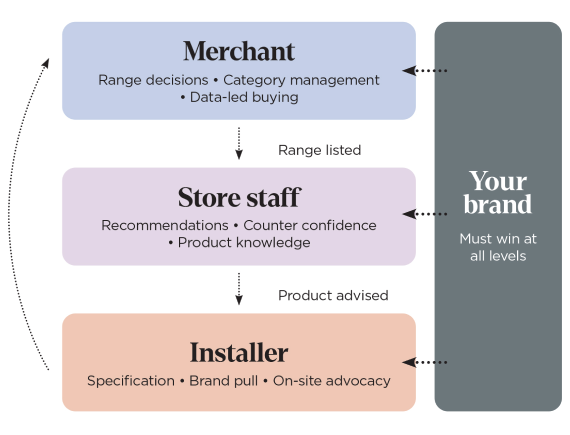
The Merchant: Reduce complexity, be part of the solution
Merchants are under pressure to simplify. Your job is to make their category management easier, not harder. A focused range with clear tiering and strong velocity data behind it is far easier to defend than a sprawling product line that requires constant justification. Show up as a partner, not a passive supplier.
Store Staff: Build confidence from the inside
Counter staff are your front line and they're often overlooked. They won't put their name behind a product they don't understand or believe in. Invest in clean packaging, simple sales tools, and product training. If the person behind the counter recommends you with confidence, the push happens naturally.
The Installer: Create pull that protects your position
When a contractor asks for your product by name, delisting becomes genuinely risky for the merchant. Contractors care about reliability, fewer call-backs, and time saved on site. On-site demos, case studies, and credible trade advocates build the kind of structural demand that no spreadsheet can easily remove.
...Then we'd love to share more perspectives with you. Click below to download our unique quarterly magazine for the latest insights on all things brand and marketing in the Built Environment.